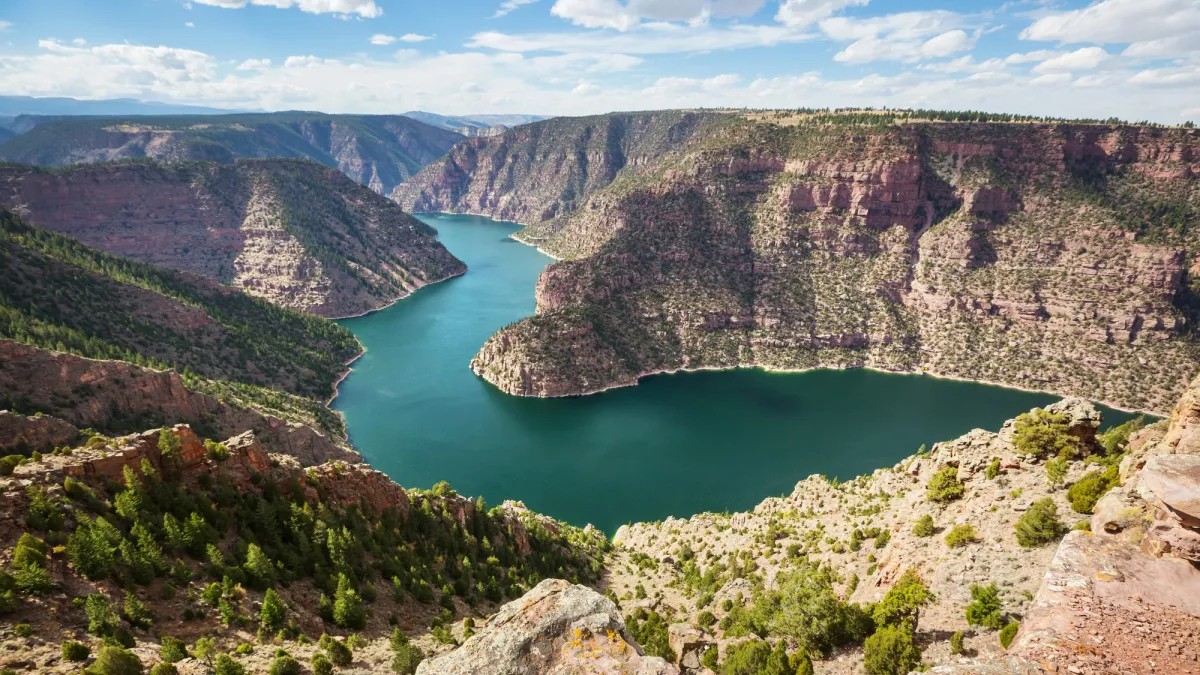
For over 150 years, geologists have puzzled over an anomaly in northeastern Utah: the Green River, a major tributary of the Colorado River, flows through a 2,300-foot-deep canyon within the Uinta Mountains. This seemingly defies basic physics—rivers typically follow the path of least resistance, not carve into elevated landmasses. Now, an international research team believes they’ve finally explained this long-standing paradox.
The Puzzle of an “Impossible” River
The Uinta Mountains are geologically young (around 50 million years old) compared to the Green River itself, which began forming less than eight million years ago. Given standard geological principles, the river shouldn’t have been able to cut through such high terrain. Previous theories suggested that the river either predated the mountains, was captured by erosion, or benefited from unusual sediment buildup. However, none adequately explained the scale and precision of the river’s course.
Lithospheric Drip: The Unexpected Solution
The breakthrough came with a novel investigation into lithospheric drip, a phenomenon where dense mineral layers sink from the Earth’s crust into the mantle. This process isn’t just theoretical; it physically pulls the overlying land downward. Researchers using seismic imaging detected a cold, round space roughly 125 miles below the Uinta Mountains, indicating a broken fragment of an ancient drip.
“We think that we’ve gathered enough evidence to show that lithospheric drip…is responsible for pulling the land down enough to enable the rivers to link and merge,” explains Adam Smith, a geologist at Scotland’s University of Glasgow.
The team estimates this drip broke away two to five million years ago, aligning with the timeline of the river’s formation. Geological modeling confirmed the hypothesis: the underlying crust beneath the Uinta Mountains is unusually thin, consistent with land rebounding after a drip event.
Why This Matters
The Green and Colorado River merger wasn’t just a geological oddity; it reshaped North America’s continental divide, separating rivers flowing to the Pacific from those reaching the Atlantic. This change in turn created new wildlife habitats, influencing species evolution. The discovery of lithospheric drip as a driving force behind this event opens doors for studying similar tectonic mysteries worldwide. This isn’t merely about resolving one puzzle; it provides a new framework for understanding how geological forces can reshape landscapes over millions of years.
The findings suggest that seemingly impossible river courses aren’t necessarily anomalies, but rather evidence of deep-seated geological processes we’re only beginning to understand.