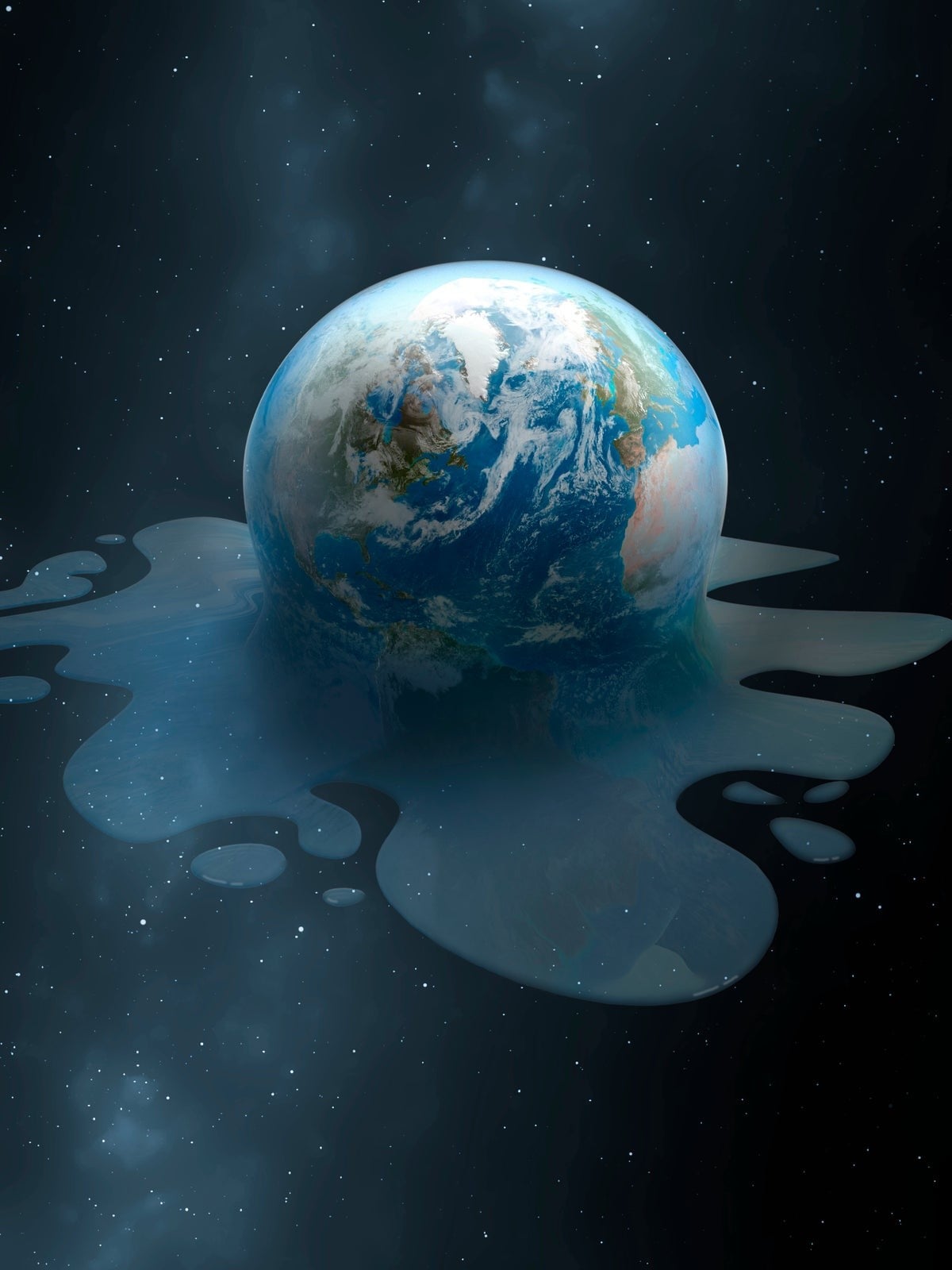
The 1980s new wave hit “I Melt With You” by Modern English poses a deceptively simple question: if you stopped the world, would it melt? While poetic, the lyric invites a surprisingly rigorous scientific analysis. The answer, it turns out, isn’t straightforward. Stopping Earth’s rotation could melt parts of it, but not in the way most people might imagine.
The Energy Required to Halt Earth
The key lies in understanding kinetic energy. Earth’s spin generates approximately 2 × 1029 joules of rotational energy—equivalent to our planet’s entire annual energy consumption stretched over half a billion years. To halt this momentum, you’d need to apply an equal amount of energy, an impossible feat without catastrophic consequences.
Consider a comparison: the asteroid that wiped out the dinosaurs released about 1023 joules. To stop Earth’s rotation using similar impacts, you’d need to replicate that event nearly a million times. The resulting devastation would be far beyond any natural disaster in recorded history.
Heat and Melting Points
Applying such massive energy to Earth wouldn’t just stop its spin; it would generate immense heat. Melting the planet entirely would require around 3 × 1030 joules, exceeding Earth’s rotational energy. However, melting just the crust—where most life exists—would take roughly 1030 joules, putting it within the realm of possibility. Even partial melting would boil away oceans and render the planet uninhabitable.
There is an alternative: slow deceleration using millions of rocket engines over millennia. This method, while theoretically possible, would still have severe environmental and logistical drawbacks.
Orbital Velocity and Total Vaporization
If “stopping the world” means halting Earth’s orbit around the sun, the energy requirements become even more extreme. It would take approximately 3 × 1033 joules—enough to not just melt, but vaporize the entire planet. In this scenario, Modern English’s lyric isn’t hyperbole; it’s an understatement.
Conclusion
The question posed by “I Melt With You” isn’t just a whimsical thought experiment. It highlights the sheer scale of energy involved in planetary motion and the devastating consequences of disrupting such systems. Depending on interpretation, stopping Earth could lead to melting, but more accurately, it would result in widespread destruction and irreversible climate change. The song’s final line, “I saw the world crashing all around your face,” is a disturbingly accurate prediction of the outcome.