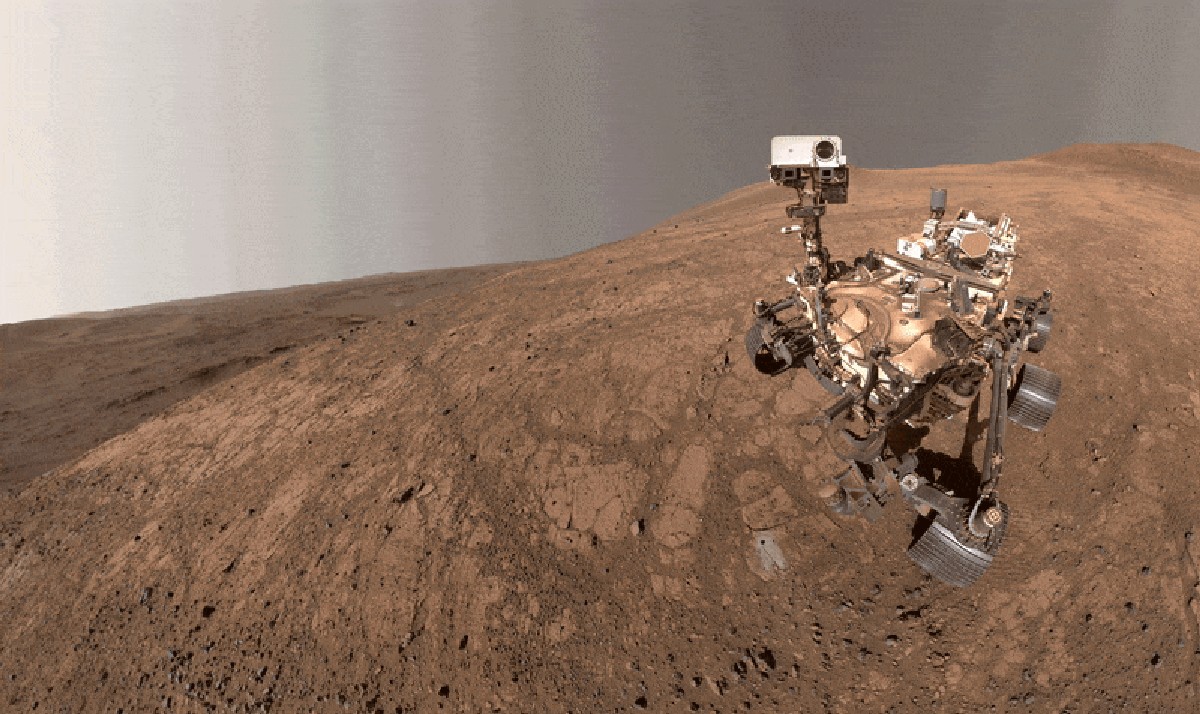
NASA scientists are devising an ambitious workaround to study a potentially groundbreaking rock on Mars – a mudstone containing intriguing patterns that could signal past microbial life. With the official Mars Sample Return program stalled due to political and financial hurdles, researchers are taking matters into their own hands: they’re attempting to recreate the rock’s unique features in Earth-based laboratories. This move is driven by the urgent need to understand whether the patterns observed on the Martian surface are evidence of ancient organisms or merely the result of non-biological chemical reactions.
The Enigmatic Cheyava Falls Rock
The rock, dubbed Cheyava Falls, was discovered by the Perseverance rover in Jezero Crater – an ancient lakebed believed to have been habitable billions of years ago. Its surface is covered in distinctive speckles and ring-shaped formations, described by scientists as “poppy seeds” and “leopard spots.” These formations are embedded with organic matter, the basic building block of life as we know it, sparking intense speculation about the possibility of past Martian life.
Why this matters: The discovery of organic matter is not, in itself, proof of life. Organic compounds can form through geological processes. However, the specific patterns in Cheyava Falls strongly resemble those created by microbial activity on Earth, making the question of origin critical.
A Race Against Time: The Lab-Based Approach
The official Mars Sample Return mission, designed to bring actual Martian rocks to Earth for detailed analysis, is facing indefinite delays. To avoid waiting until at least 2040, scientists at NASA’s Jet Propulsion Laboratory (JPL) are pursuing an alternative: replicating the rock’s conditions in controlled laboratory settings.
The plan involves creating synthetic mudstones mimicking the Martian sample, then subjecting them to various environmental factors. Some will be sterilized to rule out biological contamination, while others will be inoculated with terrestrial microbes to observe how they interact with the materials. The goal is to determine whether the “poppy seeds” and “leopard spots” can form through purely geological processes or require biological intervention.
The Chemistry Behind the Mystery
The patterns on Cheyava Falls are linked to oxidation-reduction (redox) reactions involving iron and sulfur. These reactions are fundamental to life, providing energy and protection for organisms, but they can also occur without life. The key lies in determining which pathway is more likely to have produced the observed formations.
- Geological Pathway: High temperatures (over 150°C) could drive the necessary redox reactions over millions of years. However, Perseverance has found no evidence of such extreme heating on Mars.
- Biological Pathway: Microbes on Earth can catalyze these reactions at much lower temperatures, making it a more plausible scenario. The presence of abundant organic matter in Cheyava Falls further supports this possibility.
The puzzle: Both pathways yield the same final products, making it challenging to distinguish between them.
Recreating Martian Conditions on Earth
Scientists are meticulously reconstructing the conditions of ancient Mars in their laboratories. This includes simulating atmospheric pressure, temperature, and chemical composition. Synthetic mudstones are being crafted with varying levels of organic matter, acidity, and salinity to replicate the environment in which Cheyava Falls formed.
To ensure accurate results, experiments will include:
- Sterilization: Using dry heat microbial reduction (DHMR) to eliminate any existing microorganisms.
- Biological Inoculation: Introducing terrestrial microbes known to thrive in similar conditions.
The Search for Independent Confirmation
While the laboratory experiments will provide valuable insights, scientists emphasize the need for additional evidence from Mars itself. Perseverance is still actively exploring Jezero Crater, searching for other rocks with similar geochemical signatures. Finding independent corroboration will be crucial to strengthening any claims of past life.
“You don’t just want one line of evidence. You want something completely independent of it pointing in the same direction,” says geobiologist Michael Tice.
The Perseverance team acknowledges that the work ahead is demanding, but the potential reward – definitive proof of life beyond Earth – makes it a worthwhile pursuit. The race to understand Cheyava Falls has begun, and the answers may lie not on Mars, but in the carefully controlled environments of Earth’s laboratories.